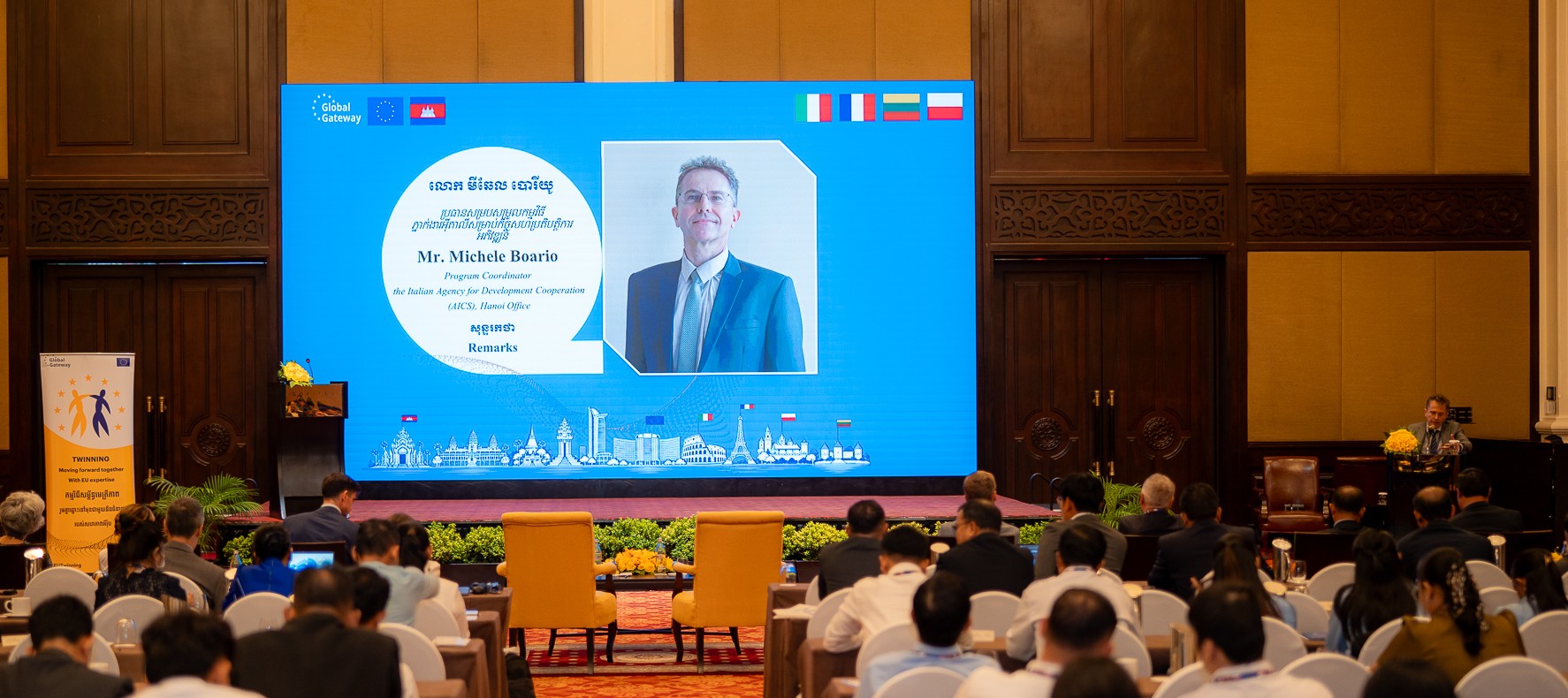
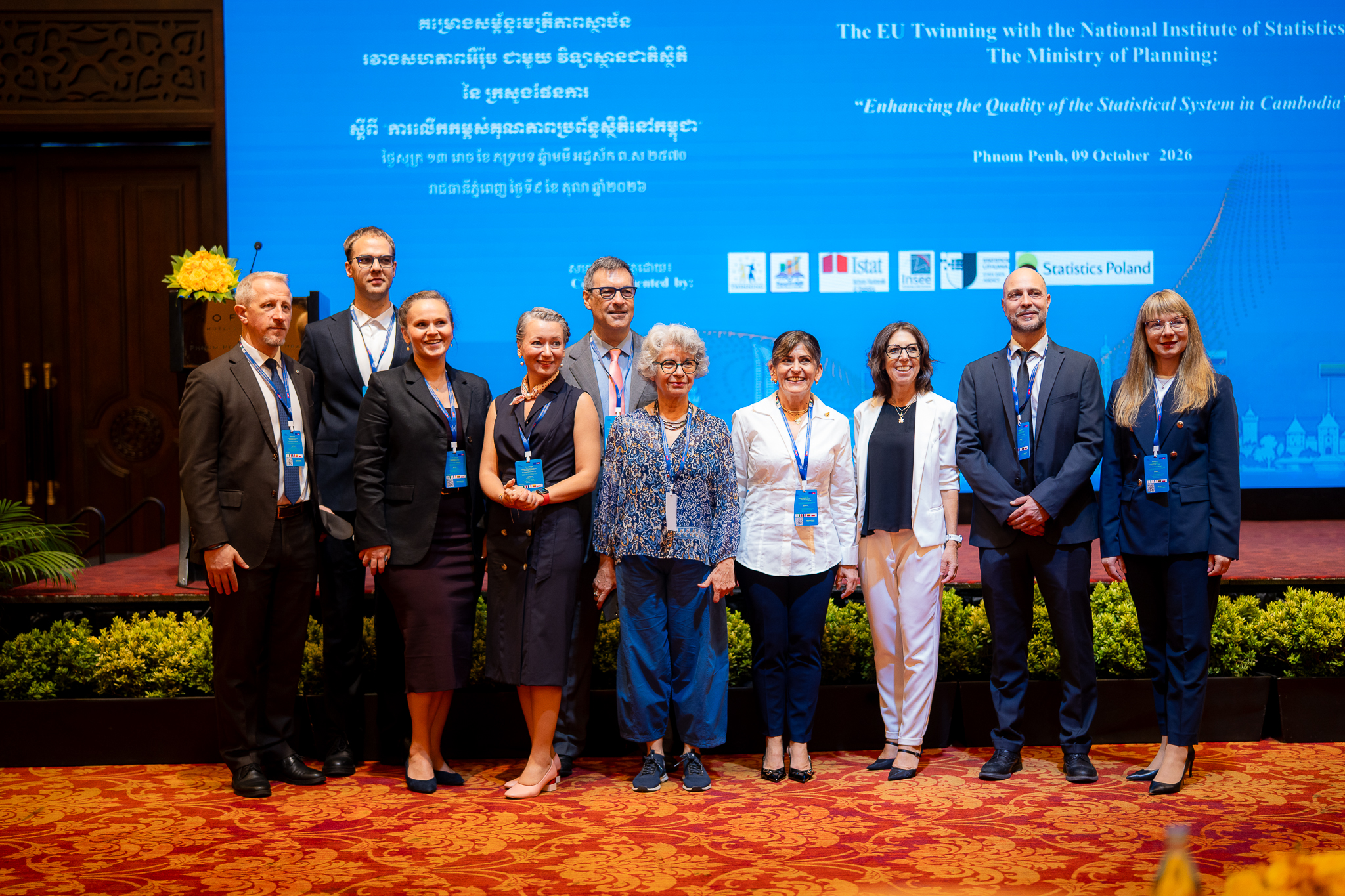
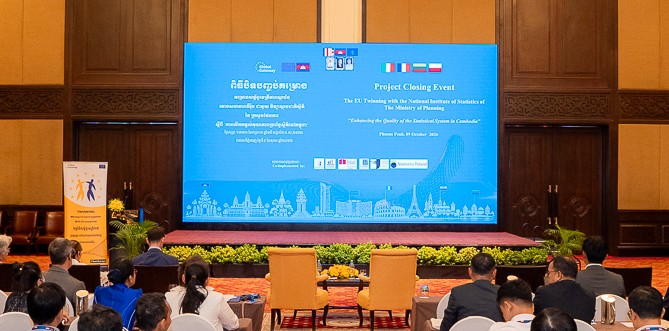
On 9 October 2026, the closing event of the European Union Twinning project “Enhancing the Quality of the Statistical System in Cambodia” took place in the capital Phnom Penh. The project focused on strengthening Cambodia’s national statistical system. AICS Hanoi participated in the event at the invitation of the Delegation of the European Union to Cambodia, with a view to exploring opportunities for continuing European and Italian cooperation in this field.
Funded by the European Union and implemented over 30 months, the project was Cambodia’s first Twinning initiative. The consortium was led by the Italian National Institute of Statistics (ISTAT), with the participation of counterpart institutions from France, Poland and Lithuania.
Twinning is an EU cooperation instrument that promotes the exchange of expertise and technical assistance between public administrations. In this case, collaboration with Cambodia’s Ministry of Planning and National Institute of Statistics (NIS) translated the Team Europe approach into a joint institutional capacity-building process, based on the exchange of expertise and the priorities of local institutions.
The main results presented included improvements in statistical quality management processes, the strengthening of annual and quarterly national accounts, and the development of safer and more interoperable data exchange systems. The project also provided training activities, study visits and internships, alongside initiatives supporting women’s leadership and the development of professional networks. Attention was also devoted to the use of statistics in public policymaking and to strengthening trust in official statistical information.
In this context, the Italian-funded initiative “Strengthening Statistical Capacity to Improve Climate Change Management in the Mekong Region” is taking shape. Funded by the Italian Government, implemented by ISTAT and monitored by AICS, the project is currently in its start-up phase and involves Vietnam, Laos and Cambodia. It offers an opportunity to build on the tools, expertise and relationships developed through the European Twinning experience.
The Italian initiative identifies water-related and urban environmental statistics as two priority areas, with an emphasis, wherever possible, on analyzing territorial disparities within the participating countries. Technical assistance will focus on producing and updating environmental and climate indicators, with particular attention to extreme weather events, disasters and climate change adaptation.
The trilateral dimension of the initiative will build on the European experience by promoting the exchange of knowledge and methodologies among the statistical institutes of the three countries. Vietnam, which has already benefited from a previous Italian cooperation initiative implemented by ISTAT, will be able to progressively take on a role as a reference point and peer-support partner. Cambodia, in turn, will be able to draw on the expertise developed through the Twinning project and contribute to regional knowledge-sharing. The objective is to foster mutual learning and the exchange of methodologies while respecting each country’s specific national priorities.
Through this initiative, AICS Hanoi aims to contribute to the development of regional statistical cooperation that strengthens public institutions’ capacities and expands the availability of reliable data. Such data are essential for informing environmental and development policies and supporting more effective decision-making in response to the challenges posed by climate change.